.png&w=1920&q=75)
Medical
Paramedical
Engineering
Pharmacy
Nursing
Management
Diploma
Science
Law
Study Abroad
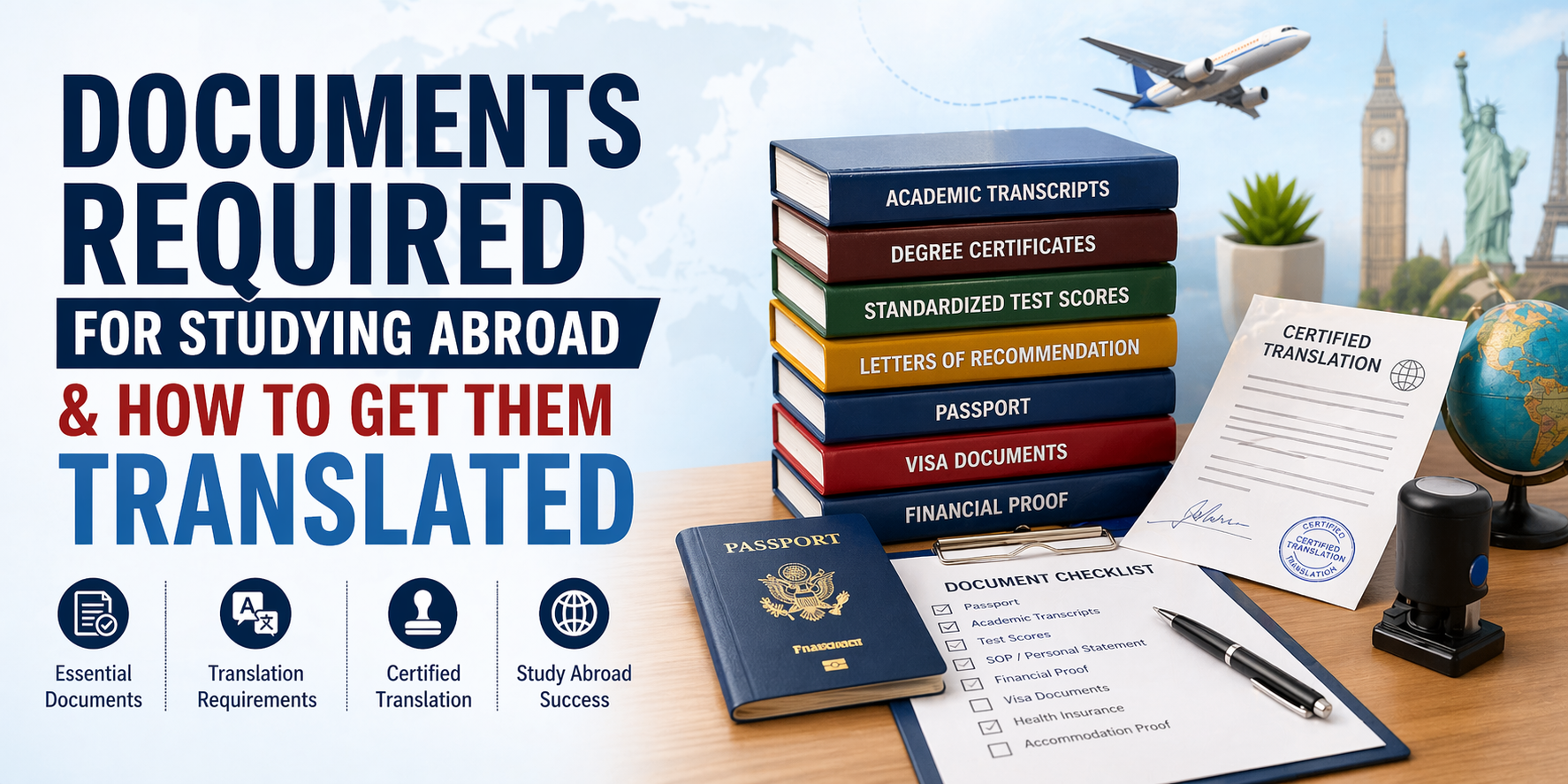
Documents Required for Studying Abroad & How to Get Them Translated
Updated: April 22, 2026
0 mins read
108 View

0
Manager Content
0 mins read
0 View
Share
Table of content
Introduction to Studying Abroad Documentation
Essential Documents for Studying Abroad
Academic Documents Required
Administrative and Legal Documents
Which Documents Need Translation
Types of Document Translation Explained
How to Get Your Documents Translated
Choosing the Right Translation Service
Tips to Keep Your Documents Organized
Country-Specific Document Requirements
Common Mistakes to Avoid
Conclusion
Studying abroad is one of the most rewarding decisions you can make for your academic and personal growth. But before you pack your bags, all your documents need to be in order to avoid last-minute surprises.
Universities, embassies, and immigration authorities have strict document requirements, including that documents not in the country's language must be translated. Failure to do this can lead to your documents being delayed, or worse, rejected.
In this guide, we’ll break down the key documents by category, which ones require translation, and how to get them translated the right way.
Essential Documents for Studying Abroad
Every country and institution has its own requirements, but it’ll typically be a combination of academic and administrative documents. Here’s what you’ll mostly need;
Academic Documents
Academic Transcripts & Certificates: Your full academic record, including grades, degrees, and certificates from previous institutions.
Standardized Test Scores: Depending on your destination and program, you may need IELTS, TOEFL, GRE, GMAT, SAT, or other test results submitted directly or as certified copies.
Letters of Recommendation: Typically, two to three letters from professors or employers. These should be on official letterheads and, if required, translated by a certified professional.
Statement of Purpose (SOP) / Personal Statement: A written essay explaining your academic goals, motivations, and reasons for choosing the program. Submit this in the language of the country you’re studying in.
Administrative & Legal Documents
Valid Passport: Your passport must be valid for at least six months beyond your intended stay.
Student Visa & Application Forms: Required for most international students. The specific visa type depends on your destination country (e.g., F-1 for the US, Tier 4 for the UK, or a national study visa in Europe).
Financial Proof / Bank Statements: These are used to show that you can support yourself financially during your studies and typically include the last three to six months of your bank activity.
Health / Medical Records & Insurance: Some universities and countries want proof that you are medically healthy and capable. So they may require documents like proof of vaccinations, a medical fitness certificate, or proof of health insurance coverage.
Birth Certificate: This is one of the most important documents for visa applications and university enrolment, often used to verify your nationality and identity.
Proof of Accommodation: Sometimes, you may need to provide proof of where you’ll be staying, especially for visa processing.
Which Documents Need to be Translated?
You’ll need to translate your documents if you’re applying to a non-English-speaking country or if they are in a language that is not the country’s official language.
The documents you’ll need to translate include;
Academic transcripts and degree certificates
Birth certificate
Bank statements and financial documents
Medical records and vaccination history
Police clearance certificates (if required)
Note: This is a general list. For a more complete list, check the requirements for the program and country you’re applying to, so nothing gets left out.
About Translation
Different types of translation are often required in different countries. For example, in countries like the UK or the US, you’ll often need certified translations of your documents. However, this differs in countries such as Germany, Spain, and Brazil, where you’ll need a sworn translation.
Notably, all these translations mean the same thing, but are called different things. A certified translation is a translation completed by a professional translator and accompanied by a signed statement from the translator or translation agency confirming its accuracy and completeness. In Germany, it is called a sworn translation; however, the translator must be sworn in by a German court.
Other countries like France and the UAE may require a notarized translation, and this is entirely different. A notarized translation is a certified translation, in which the translator and their signature have been verified by a notary public. After this verification is done, the notary affixes their stamp and signature on the document, officially making it notarized.
Most of the time, you’ll only need a certified translation. Luckily, several online translation agencies offer this service.
How to Get Your Documents Translated
Once you know which documents need to be translated, here’s how to do it right.
1. Know the Type of Translation You Need
As explained earlier, you may be asked to get an official, sworn, or certified translation. They all refer to the same thing. Confirm with the receiving authority on what type of translation you need to submit, and use professional translation services.
2. Use a Certified Translation Service
This is the most reliable option for official documents. Certified translations are handled by trained professionals who specialise in legal and academic terminology. Look for services accredited by recognised bodies such as the American Translators Association (ATA) or equivalent organisations in your country. Always confirm that the service provides a signed certificate of accuracy with the translated document.
2. Check Your University's Preferred Translator List
Some universities and colleges abroad maintain a list of approved translation providers. Using an institution's preferred vendor saves time during verification and reduces the risk of your documents being rejected.
3. Go Through Embassy-Approved Services
For visa applications, many embassies require translations from specific approved agencies or sworn translators. Check the official embassy website of the country you're applying to for their exact requirements before commissioning any translation work.
What to look for in a translation service:
Accuracy and subject-matter expertise (especially for academic or legal texts)
Turnaround time, embassy appointments and admission deadlines won't wait
An official stamp, signature, or certification will be included with the document
Experience with the specific country or institution you're applying to
Tips to Keep Your Document Organized
A visa application is one of the most tedious things you’ll do. Gathering your documents, reaching out to the issuing authorities for the originals, knowing which ones need to be translated, requesting translations, getting photocopies, it’s a lot.
And because it’s a tedious process, it’s easy to get disorganized and lose track of your documents. To avoid this, here are some practical tips to help you;
Start Early: Translation services can take anywhere from a few days to several weeks, depending on the language pair and document complexity. Don't leave it until after you've received an admission offer.
Keep Digital and Physical Copies: Scan every document and store copies in a secure cloud folder. Carry physical copies in a clearly labelled folder when travelling.
Check Your Destination Country's Specific Requirements: Requirements vary significantly. Germany may need apostilled translations. Japan may require Japanese-language documents. The UAE may need notarisation. Always verify with the official embassy or consulate website.
Follow Your University's Document Checklist: Most institutions publish a detailed checklist for international applicants. Use it as your master reference and tick items off as you go.
Track Expiry Dates: Some documents, such as bank statements, police clearance certificates, and medical reports, have a validity period. Make sure everything is up to date before submitting.
Conclusion
Studying abroad is a life-changing experience, and the document process, although tedious, is simply the first step on that journey. Getting your paperwork right from the start means fewer delays, less stress, and a smoother path to your dream institution.
At GetMyCollege, we help students navigate every step of the study abroad process, from shortlisting the right institutions to guiding you through documentation and admission requirements. Get in touch today and let us help you turn your study abroad dream into a reality.
.png)