.png&w=1920&q=75)
Medical
Paramedical
Engineering
Pharmacy
Nursing
Management
Diploma
Science
Law
Study Abroad
Can B.Tech Graduates Apply for NABARD Grade A? Eligibility and Preparation Strategy
Updated: April 24, 2026
0 mins read
131 View

0
Manager Content
0 mins read
0 View
Share
Table of content
- Can B.Tech Graduates Apply for NABARD Grade A?
- Eligibility Criteria for B.Tech Graduates
- Age Limit and Relaxation
- Work Experience Requirement
- The Real Challenge for B.Tech Candidates
- NABARD Grade A Syllabus Overview
- Preparation Strategy for B.Tech Graduates
- Choosing the Right Stream for B.Tech Candidates
- Final Thoughts
Yes, B.Tech graduates can apply for NABARD Grade A. But the answer comes with important details, most importantly NABARD Grade A syllabus that depend on which stream you apply for.
Eligibility for B.Tech Graduates
NABARD recruits Assistant Managers across multiple streams. Your B.Tech degree can qualify you for more than one of them.
RDBS General Stream
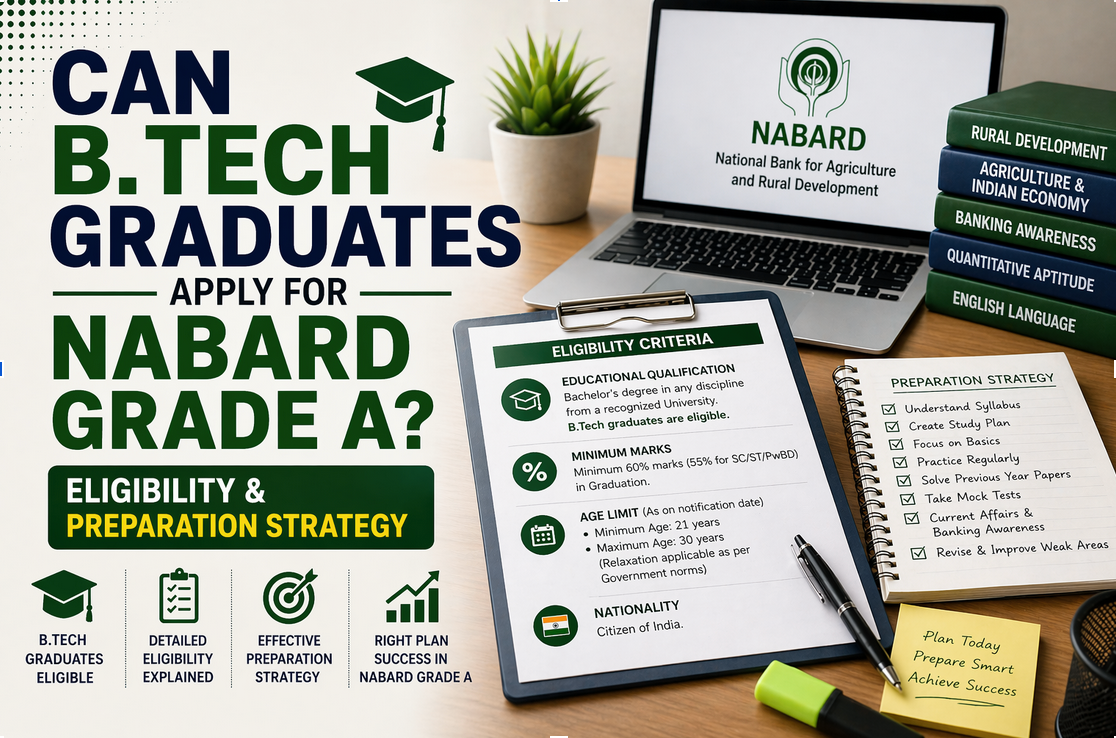
This is the most popular stream. A Bachelor's Degree in any subject from a recognized university with a minimum of 60% marks (55% for SC/ST/PwBD) is required.
A B.Tech degree in any branch: Mechanical, Civil, Electronics, Computer Science, qualifies here.
A B.Tech degree alone is sufficient. No additional subject requirement is specified for the RDBS General stream.
IT Stream
Candidates must have a four-year Bachelor's Engineering or Technology Degree in Computer Science, Computer Technology, Computer Applications, or IT from a recognized university with 60% marks (55% for SC/ST/PwBD).
B.Tech in CS, IT, or related fields fits directly here.
Civil Engineering Stream
NABARD also recruits for Civil Engineering posts.
B.Tech in Civil Engineering qualifies directly for this stream.
Age Limit
Candidates must be between 21 and 30 years of age as on the specified date in the notification.
Age relaxation of 5 years is available for SC/ST candidates, 3 years for OBC, and 10 years for PwBD candidates.
No Work Experience Required
The NABARD Grade A exam does not generally impose any mandatory work experience requirement. Fresh graduates are fully eligible.
The Real Challenge for B.Tech Candidates
Eligibility is the easy part. The harder reality is the NABARD Grade A syllabus.
B.Tech programs cover no Agriculture and Rural Development, and very little Economics. These two subjects: ESI and ARD, are the most important sections in the exam.
Here is why that matters. The Phase 1 exam has merit sections and qualifying sections. The qualifying sections are Reasoning, Quantitative Aptitude, English, Computer Knowledge, and Decision Making. Merit sections: ESI, ARD, and General Awareness, are crucial for both Phase 1 and Phase 2. Your rank is determined by your score in the merit sections, not the qualifying ones.
B.Tech graduates typically score well in Quant and Computer Knowledge. Those sections only need to clear the cutoff. They do not decide your rank. ESI and ARD do. These are the sections where most B.Tech candidates fall short.
Understanding the NABARD Grade A Syllabus
Phase 1 (Prelims): 200 marks, 2 hours
Sections: Reasoning, Quantitative Aptitude, English, Computer Knowledge, Decision Making, General Awareness, Economic and Social Issues (ESI), Agriculture and Rural Development (ARD).
Phase 2 (Mains)
Paper 1 is an online descriptive test covering Essay, Précis Writing, Comprehension, and Business/Office Correspondence.
Paper 2 focuses on Economic and Social Issues and Agriculture and Rural Development, with the paper including both objective and descriptive sections.
Phase 3
Psychometric test followed by an interview. The interview is worth 50 marks.
How B.Tech Graduates Should Prepare
Step 1: Solve NABARD Grade A Previous Year Papers First
Before you build a study plan, go through the NABARD Grade A previous year paper from Phase 1 and Phase 2. This is not optional.
The papers will show you exactly what ESI and ARD questions look like. Many B.Tech candidates underestimate these sections until they see the actual questions. Solving previous year papers early prevents that mistake.
Step 2: Treat ESI and ARD as Priority Subjects
These are not supplementary topics. They are the core of the exam. Spend at least 50-60% of your total preparation time on ESI and ARD.
For ESI, cover Indian economy basics, inflation, unemployment, poverty, financial institutions, banking sector reforms, and government schemes.
For ARD, focus on agricultural credit, cooperative banking, microfinance, rural development programmes like MGNREGA and PMKSY, irrigation, and NABARD's own refinance functions.
Step 3: Do Not Over-Prepare Quant
Quant is a qualifying section. You need to cross the cutoff, not top it. If you are from a B.Tech background, basic practice is enough.
Spending three months on Quant at the cost of ESI is the single most common preparation mistake among engineering graduates.
Step 4: Build General Awareness Around Agriculture and Finance
Read newspapers daily. Focus specifically on RBI policy updates, NABARD schemes, budget allocations for rural sectors, and major agricultural policy changes.
This builds both the General Awareness section and reinforces ESI and ARD content at the same time.
Step 5: Start Answer Writing Early for Phase 2
The Phase 2 descriptive paper is where many technically strong candidates lose marks. They know the content but cannot express it in essay format.
Start writing short answers on economic topics from month two of preparation. Do not leave descriptive practice for the last few weeks.
Which Stream Should B.Tech Candidates Choose?
If you are from CS or IT, the IT stream is a reasonable choice because the domain paper tests your core knowledge. But the IT stream had only 10 vacancies in 2025 out of a total of 91. Competition within this stream from CS specialists is also high.
The RDBS General stream had 85 vacancies in 2025. For most B.Tech candidates, this stream offers more seats. The domain knowledge gap in ESI and ARD is real, but it is bridgeable with 5-6 months of focused preparation.
The choice depends on your subject comfort and how much time you can invest in building economics and agriculture knowledge from scratch.
.png)