.png&w=1920&q=75)
Medical
Paramedical
Engineering
Pharmacy
Nursing
Management
Diploma
Science
Law
Study Abroad

Admissions open 2026-27
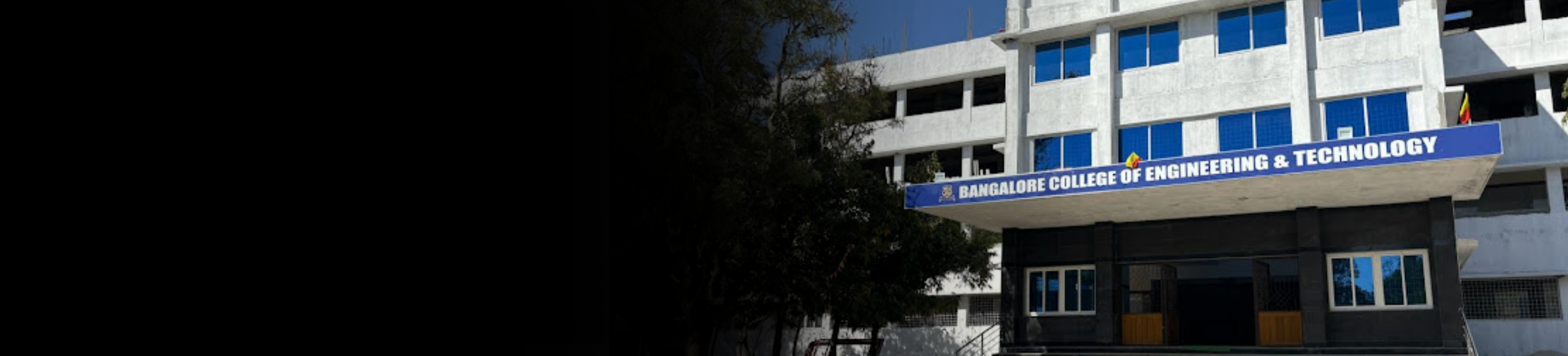
Bangalore College of Engineering
Visvesvaraya Technological University (VTU),Engineering
Road Bangalore East Taluk, Bangalore, India
CUT OFF
| Courses | Fees | CutOff / Eligibility Criteria |
|---|---|---|
| B E Civil Engineering | 4.4L | 98,000 |
| B.E Mechanical Engineering | 4.4L | 82,000 |
| B E Electronics & Communication Engineering | 4.4L | 50,394 |
| B.E Computer Science Engineering | 6.4L | 39,588 |
| Computer Engineering | 4.4L | 45,000 |
| Artificial Intelligence & Machine Learning | 6.4L | 52,976 |
| Robotics & Machine Learning | 4.4L | 67,000 |
The Bangalore College of Engineering and Technology Cutoff (BCET) is the minimum rank or score that candidates need to meet to gain admission to the various undergraduate and postgraduate programs offered by the college. The cutoff depends on several factors, including the entrance exam (KCET, COMEDK, or PGCET). Cutoffs are essential for determining whether a student qualifies for admission to BCET. The significance of the cutoff can be broken down into the following: Merit-Based Admission: The cutoff is used to ensure that only those who have achieved a certain level of academic performance or exam results are admitted. Branch Allocation: High-demand branches like Computer Science and Engineering (CSE) and Electronics & Communication Engineering (ECE) typically have higher cutoffs, while branches like Civil or Mechanical Engineering may have lower cutoffs. Category Reservations: Students belonging to reserved categories (SC/ST/OBC) are given relaxation in the cutoff as per government regulations, allowing them to secure seats in the institution with relatively lower scores compared to the general category students. Seat Availability: The availability of seats in various branches plays a critical role in determining the cutoff. Popular branches tend to have a higher cutoff due to limited availability. The cutoff at BCET fluctuates year-to-year based on several factors, all of which impact the final cutoff marks or rank for admission. Some of the key factors include: The number of candidates appearing for KCET, COMEDK, or PGCET directly influences the cutoff. More applicants generally lead to a higher cutoff, as the competition for available seats intensifies. The difficulty level of the entrance exams plays a pivotal role. A tougher exam generally results in a lower cutoff as students struggle to achieve higher ranks. Conversely, easier exams may lead to higher cutoffs. The total number of seats in each branch also affects the cutoff. Limited availability in high-demand branches like CSE or ECE leads to higher cutoffs, whereas branches with fewer seats, such as Civil Engineering, may have a relatively lower cutoff. Candidates belonging to SC, ST, OBC, and other reserved categories are given certain relaxations in the cutoff. For example, a student from an SC category may have a significantly lower cutoff compared to a candidate from the general category. Previous year cutoffs provide a good indication of what students can expect in terms of cutoff marks or ranks. If the previous year’s cutoff was high, it might remain stable or slightly increase for the next year based on the factors mentioned above. The popularity of certain branches also directly impacts the cutoff. For example, Computer Science and Engineering (CSE) consistently sees a high demand, and hence, the cutoff for CSE tends to be significantly higher than for branches like Mechanical or Civil Engineering. The cutoff at BCET varies depending on the admission route (KCET, COMEDK, PGCET) and the category of the candidate (General, OBC, SC, ST, etc.). Each category follows specific guidelines set by the college and government. For students who are domiciles in Karnataka, the Karnataka Common Entrance Test (KCET) is the primary method of admission to BCET. The cutoff for KCET is determined by the Karnataka Examinations Authority (KEA) and is based on the rank achieved by the candidate in the exam. The cutoff ranks for KCET are typically released in multiple rounds of counseling and are subject to variations each year. Eligibility: Students must have passed their 12th-grade examination with Physics, Chemistry, and Mathematics as core subjects. Ranking: The KCET rank is determined by considering 50% of the marks in the qualifying examination and 50% from the KCET score. For students outside Karnataka, COMEDK UGET is the most common entrance exam. The cutoff for COMEDK is generally higher than for KCET, as the exam is competitive and students from all over India participate. The cutoff is determined based on the score a candidate achieves in the COMEDK exam, and the ranks are allocated accordingly. Eligibility: Students must have a valid COMEDK UGET rank card, and they must meet the required marks in their 12th-grade exams. Ranking: The cutoff ranks are announced after the results of COMEDK UGET are declared, and they vary depending on branch and category. Management quota seats at BCET allow for direct admission without going through the centralized counseling process. The cutoff for these seats is not strictly defined, as management quota admissions are based on academic merit, interviews, or other criteria determined by the college. Flexibility: Students seeking admission through the management quota may not need to meet the cutoff ranks set by KEA or COMEDK. Fee Structure: Management quota seats usually have a higher fee structure compared to merit-based seats, and this is a key factor to consider. The Postgraduate Common Entrance Test (PGCET) is applicable for candidates seeking admission to M.Tech and MBA programs at BCET. The cutoff for PGCET is based on the rank secured in the PGCET exam and varies by specialization. Eligibility: Students must have a valid PGCET rank card. For M.Tech programs, candidates must have completed a relevant undergraduate degree, and for MBA programs, a bachelor's degree in any stream is required. Ranking: The PGCET cutoff is announced by the Karnataka Examination Authority (KEA) after the examination results are declared. The cutoff for each branch at BCET varies depending on the competition and demand for that particular branch. Below is a detailed analysis of the branch-specific cutoff trends for BCET: Computer Science and Engineering (CSE): One of the most competitive branches, with cutoffs ranging from 20,000 to 35,000. Candidates aspiring for CSE should aim for top ranks in both KCET and COMEDK exams. Electronics and Communication Engineering (ECE): Another popular branch, with cutoff ranks between 30,000 and 45,000. ECE sees relatively less competition compared to CSE but remains competitive due to its scope in the job market. Mechanical Engineering: With cutoffs between 50,000 and 65,000, Mechanical Engineering is generally easier to get into compared to CSE and ECE, though it still remains a popular choice. Civil Engineering: The cutoff for Civil Engineering typically ranges from 60,000 to 75,000, as it is in moderate demand compared to more technical branches like CSE or ECE. Information Science and Engineering (ISE): The cutoff for ISE ranges from 25,000 to 40,000, making it a competitive but slightly less competitive branch than CSE. M.Tech in Computer Science tends to have a higher cutoff, reflecting its popularity. BCET follows government norms for reservations, which means that the cutoff for reserved category students (SC, ST, OBC) is typically lower than for general category students. Here’s a breakdown of category-wise cutoffs for various branches: Reserved category students are given a relaxation in cutoff ranks, making it easier for them to secure admission to their desired programs. For more details about the cutoff analysis at the Bangalore College of Engineering Cutoff Criteria. The cutoff trends at BCET have evolved over the years, reflecting changes in competition, seat availability, and demand for specific branches. As seen in the table, cutoffs have gradually become more competitive, particularly for high-demand branches like CSE. However, branches like Civil Engineering have seen a slight reduction in cutoff ranks. For more details about the year-wise list at the Bangalore College of Engineering and Technology Cutoff. To secure a place at BCET, candidates should focus on the following strategies: Preparation: Consistent and focused preparation for KCET, COMEDK, or PGCET is essential. Time Management: Practice solving questions within time limits to improve speed and accuracy during the exam. Mock Tests: Regularly take mock tests to assess performance and identify areas for improvement. Category Consideration: Reserved category students should ensure they understand the specific relaxation criteria and apply them accordingly. For more details about the cutoff criteria at the Bangalore College of Engineering and Technology COMEDK Cutoff. The Bangalore College of Engineering and Technology Cutoff plays a role in determining a candidate's securing admission. Understanding the factors influencing the cutoff, branch-specific trends, & category-wise variations can significantly improve a candidate’s strategy for admission. Staying updated on cutoff trends each year and preparing accordingly can make the difference between securing a seat and missing out on opportunities at BCET.1. Importance of Cutoffs
2. Determinants of Bangalore College of Engineering and Technology Cutoff.
A. Number of Applicants
B. Difficulty Level of the Entrance Exam
C. Availability of Seats
D. Category-Based Relaxations
E. Previous Year Cutoff Trends
F. Popularity of the Branch
3. Bangalore College of Engineering and Technology COMEDK Cutoff
A. KCET Cutoff
B. COMEDK UGET Cutoff
C. Management Quota Cutoff
D. PGCET Cutoff
4. Branch-Specific Bangalore College of Engineering Cutoff Criteria Trends
Undergraduate Programs (B.E/B.Tech)
Postgraduate Programs (M.Tech/MBA)
5. Category-Wise Cutoff Analysis
6. Trends Over the Years
7. Strategies to Meet Cutoff Criteria
Conclusion
Get College Name, District
Admission Form 2026
More About
Info
Courses & Fees
Admission
Placements
Scholarship
Gallery
Facility
Review
Q & A
Students Also Visited

College Name
Admissions Open for All Courses 2026
Visit Us
Basavanagudi, Bengaluru
Karnataka - 560004
.png)
GetMyCollege
India's most trusted college admission platform. Join thousands of students who found their dream college with expert guidance.
Company
About Us
Compare Colleges
Contact Us
Privacy Policy
Terms & Conditions
Ready to Find Your Dream College?
Free counselling available — no registration required
Top Colleges
RV Institute of Technology and Management
PES College of Engineering
BMS Institute of Technology and Management
Dayananda Sagar Institute of Technology
BNM Institute of Technology
Sir M Visvesvaraya Institute Of Technology
RNS Institute of Technology
Top Streams
Medical
Para Medical
Engineering
Nursing
LLB
Science
Arts & Design
Diploma
Pharmacy
Commerce
IT
Study Abroad
🇨🇦 Canada
🇸🇪 Sweden
🇦🇺 Australia
🇩🇪 Germany
🇬🇧 UK
🇺🇸 USA
🇫🇷 France
🇨🇳 China
🇦🇪 UAE
🇮🇹 Italy
🇳🇿 New Zealand
Articles
Pre University Result
PU College Admissions 2026
CBSE 10th Exam Syllabus
Best PU Colleges in Bangalore
JEE, NEET with PU Colleges
Why BBA after 12th
Engineering Revaluation Complete Guide
Top Residential PU Colleges in Bangalore
Copyright © 2026
GetMyCollege.com.
All Rights Reserved.