.png&w=1920&q=75)
Medical
Paramedical
Engineering
Pharmacy
Nursing
Management
Diploma
Science
Law
Study Abroad

Admissions open 2026-27
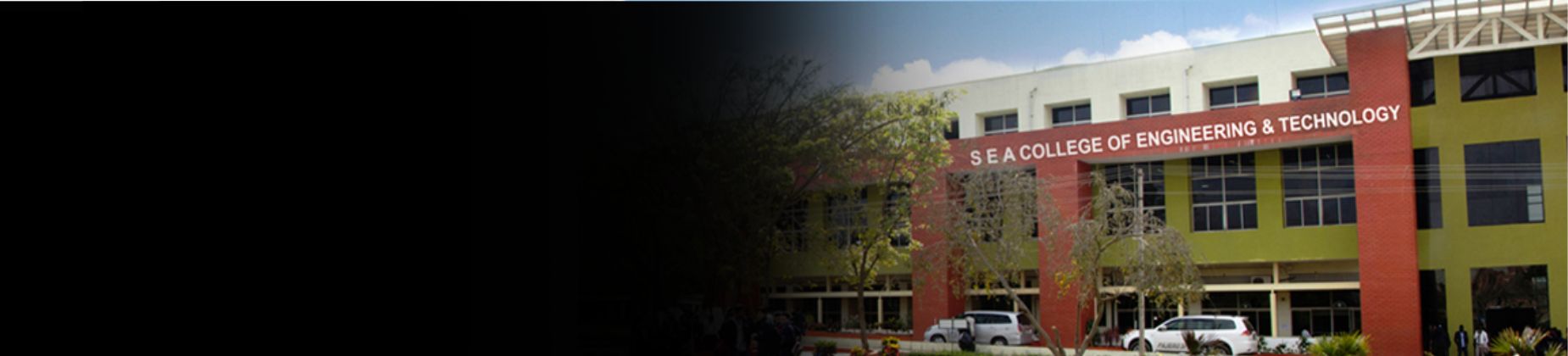
SEA College of Engineering & Technology
Visvesvaraya Technological University (VTU),Engineering
K R Puram, Bangalore, India
CUT OFF
| Courses | Fees | CutOff / Eligibility Criteria |
|---|---|---|
| Department of Civil Engineering | 8L | 1,80,000 |
| Department of Information Science & Engineering | 16L | 65,000 |
| Department of Mechanical Engineering | 8L | 1,50,000 |
| Department of Artificial Intelligence & Machine Learning | 16L | 61,000 |
| Department of Electronics & Communication Engineering | 12L | 75,000 |
| Department of CSE (IoT & Cyber Security including Blockchain Technology) | 16L | 70,455 |
| Department of Computer Science & Engineering | 16L | 55,353 |
The SEA College of Engineering and Technology KCET Cutoff marks for admission play a pivotal role in determining a student's eligibility for various programs at the SEA College of Engineering and Technology (SEA CET), cutoffs are essential benchmarks that represent the minimum score required to gain admission into a particular course or discipline. These marks are influenced by multiple factors including the number of applicants, seat availability & the performance of candidates in entrance exams. Cutoff marks are essentially the lowest rank or score a candidate must achieve in an entrance exam to secure admission to a specific course at SEA CET. The college adheres to the cutoff scores released by the relevant examination authorities, such as: Karnataka Common Entrance Test (KCET): For undergraduate engineering programs, KCET cutoffs are a key determinant for state quota admissions. COMEDK UGET: For non-Karnataka students or those applying through the management quota, COMEDK scores serve as the basis for admission. Postgraduate Entrance Tests: For programs like M.Tech and MBA, cutoffs are determined by scores in Karnataka PGCET or national-level exams such as GATE and CAT. The cutoff marks vary annually and across courses, depending on several dynamic factors. The cutoff criteria at SEA CET are shaped by a combination of factors: Exam Difficulty Level: The complexity of the entrance exam directly impacts the cutoff. A more challenging paper usually results in lower cutoffs. Number of Applicants: A higher number of applicants increases competition, leading to elevated cutoff scores. Seat Availability: Limited seats in high-demand courses tend to raise the cutoff thresholds. Reservation Policy: The allotment of reserved seats for SC/ST, OBC, and other categories influences the general cutoff. Previous Year Trends: Historical data on cutoffs serves as a benchmark for determining the current year’s cutoff. To learn more information and details about the cutoff criteria, visit SEA College of Engineering and Technology KCET Cutoff. The cutoff marks at SEA CET are typically categorized based on the type of admission: A. KCET Cutoffs For Karnataka domicile students, admissions to undergraduate engineering programs are primarily based on KCET scores. The KCET cutoffs are released by the Karnataka Examination Authority (KEA) and vary by discipline. Branch-Specific Cutoffs: Popular branches such as Computer Science and Electronics Engineering generally have higher cutoffs due to demand. Category-Wise Cutoffs: Separate cutoffs are issued for General, SC, ST, OBC, and other categories. Quota-Specific Cutoffs: Students applying under government quotas usually have lower cutoffs compared to those applying under management quotas. B. COMEDK UGET Cutoffs For non-Karnataka students, the COMEDK UGET scores determine admission eligibility. These cutoffs are typically higher than KCET cutoffs since they cater to a broader pool of applicants. Important considerations include: Discipline Variation: Streams like Artificial Intelligence and Data Science often have stringent cutoffs due to their industry relevance. Management Quota: Applicants under the management quota may face less competitive cutoffs but often need to meet a minimum eligibility threshold. C. Postgraduate Cutoffs For M.Tech and MBA programs, SEA CET considers entrance exams like Karnataka PGCET, GATE, and CAT. Highlights of these cutoffs include: M.Tech Programs: GATE scores often have a higher weightage, and cutoffs vary by specialization (e.g., Mechanical Engineering vs. Computer Networks). MBA Program: For MBA admissions, scores in exams like CAT, MAT, and Karnataka PGCET are evaluated. A higher percentile in CAT typically correlates with greater chances of admission. The cutoff marks for various engineering disciplines at SEA CET differ significantly based on demand and academic rigor. Below is an overview of branch-wise trends: Computer Science and Engineering (CSE): Typically has the highest cutoffs due to strong industry demand and lucrative career prospects. KCET cutoff: Around 5,000–10,000 ranks. COMEDK cutoff: Around 3,000–8,000 ranks. Electronics and Communication Engineering (ECE): A popular choice among students interested in core engineering and technology. KCET cutoff: Around 8,000–15,000 rank. COMEDK cutoff: Around 5,000–12,000 rank. Mechanical Engineering: Demand for this branch has seen fluctuations but remains a steady choice for core engineering aspirants. KCET cutoff: Around 15,000–25,000 rank. COMEDK cutoff: Around 12,000–20,000 ranks. Civil Engineering: Attracts students interested in infrastructure and construction-related careers. KCET cutoff: Around 20,000–35,000 ranks. COMEDK cutoff: Around 18,000–30,000 ranks. Artificial Intelligence and Machine Learning: A relatively new and in-demand field, resulting in competitive cutoffs. KCET cutoff: Around 4,000–8,000 ranks. COMEDK cutoff: Around 2,000–6,000 ranks. To learn more information and details about the cutoff criteria, visit SEA College of Engineering and Technology. Analyzing historical data provides valuable insights into cutoff trends at SEA CET. Below are some observations: Steady Increase: Cutoffs for branches like CSE and ECE have steadily increased due to growing demand. Emerging Fields: Newer disciplines like AI and Data Science have seen sharp increases in cutoff marks. Fluctuations in Core Streams: Traditional streams such as Mechanical and Civil Engineering have shown variability in cutoffs depending on market demand. Students can access cutoff scores through the following means: Official Website: The college’s website publishes cutoff details for all courses. KEA Portal: For KCET cutoffs, the Karnataka Examination Authority portal provides detailed information. COMEDK Website: The official COMEDK website lists the cutoff ranks for participating colleges. Admission Brochures: SEA CET’s admission brochures include cutoff data for reference. To secure admission to SEA CET, candidates must aim to meet or exceed the cutoff marks. Here are some preparation strategies: Understand Exam Patterns: Familiarize yourself with the exam structure and types of questions asked in KCET, COMEDK, or PGCET. Focus on Core Subjects: Prioritize Physics, Chemistry, and Mathematics for engineering entrance exams. Practice Mock Tests: Regularly practice mock tests and previous years’ papers to improve accuracy and time management. Seek Professional Coaching: Consider enrolling in coaching classes if additional guidance is required. The Sea College of Engineering and Technology cutoff criteria have significant implications for students and the institution: Student Eligibility: Cutoffs ensure that only academically capable students are admitted, maintaining the institution's quality standards. Program Popularity: Higher cutoffs reflect the popularity & demand for certain programs. Seat Allocation: Cutoffs streamline the seat allocation process, ensuring fairness and transparency. To learn more information & details about the college cutoff criteria, visit the Sea College of Engineering and Technology cutoff. The SEA College of Engineering and Technology KCET Cutoff is a vital component of its admission process ensuring that deserving and competent students secure a place in their desired courses. By understanding the cutoff trends, eligibility requirements, and preparation strategies, prospective students can enhance their chances of meeting these benchmarks and gaining admission to one of Bangalore’s esteemed engineering institutions. As cutoffs fluctuate yearly based on various factors, students are advised to stay updated with the latest information and plan their preparations accordingly.SEA College of Engineering and Technology KCET Cutoff
1. Understanding Cutoff Criteria
2. Factors Influencing Cutoff Marks
3. Cutoff Categories at SEA CET
4. Branch-Wise Cutoff Trends
5. Cutoff Trends Over the Years
How to Check Cutoff Scores
Preparation Strategies for Meeting Cutoffs
Implications of Cutoff Scores
Conclusion
Get College Name, District
Admission Form 2026
More About
Info
Courses & Fees
Admission
Placements
Scholarship
Gallery
Facility
Review
Q & A
Students Also Visited

College Name
Admissions Open for All Courses 2026
Visit Us
Basavanagudi, Bengaluru
Karnataka - 560004
.png)
GetMyCollege
India's most trusted college admission platform. Join thousands of students who found their dream college with expert guidance.
Company
About Us
Compare Colleges
Contact Us
Privacy Policy
Terms & Conditions
Ready to Find Your Dream College?
Free counselling available — no registration required
Top Colleges
RV Institute of Technology and Management
PES College of Engineering
BMS Institute of Technology and Management
Dayananda Sagar Institute of Technology
BNM Institute of Technology
Sir M Visvesvaraya Institute Of Technology
RNS Institute of Technology
Top Streams
Medical
Para Medical
Engineering
Nursing
LLB
Science
Arts & Design
Diploma
Pharmacy
Commerce
IT
Study Abroad
🇨🇦 Canada
🇸🇪 Sweden
🇦🇺 Australia
🇩🇪 Germany
🇬🇧 UK
🇺🇸 USA
🇫🇷 France
🇨🇳 China
🇦🇪 UAE
🇮🇹 Italy
🇳🇿 New Zealand
Articles
Pre University Result
PU College Admissions 2026
CBSE 10th Exam Syllabus
Best PU Colleges in Bangalore
JEE, NEET with PU Colleges
Why BBA after 12th
Engineering Revaluation Complete Guide
Top Residential PU Colleges in Bangalore
Copyright © 2026
GetMyCollege.com.
All Rights Reserved.